Archaeological monuments
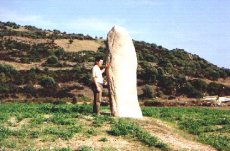 Often, close to the tomb of the giants, a single stone can be seen, accurately worked into a pointed form called a "Betili". They represented the sacred symbol of divinity and expressed the essential masculine and feminine principals that are the origin of all life.
Also the menhir, known in Sardinia by the name "Pedras Fittas", are great stones dug into the ground, sometimes natural and sometimes worked. These are also associated with cult monuments lsuch as the domus de janas and have religious relevance. They can be found all over the island.
Domus De Janas
The domus de janas were tombs dug in the rocks by the man of the copper age (pre-nuraghic) of 2700 - 1800 BC. They were made up of a various number of semi-circular cells, reached by rectangular doorways that were closed solely by a stone slab of the kind used for the walls of the dwellings of that period. The Sardinian transcription tells us that these tombs were home to both good and evil spirits, "Janas" in Sardinian (probably derived from the Latin name "Diana").
Tombe dei giganti (giants' tombs)
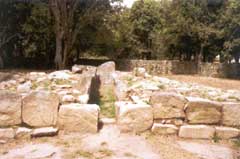 A common burial place built in stone composed of a long corridor covered by a stone slab, called "edestra" for its semi-circular shape, of about 3 metres in height. There is but one tomb for every location.
Nuragic Bronzes
Of the cult practised in the Nuraghic sanctuaries, the important function of bronze-working was carried out, objects of about 10-15cm but sometimes as large as 40cm in height were created. The study of these bronze workings is very important because it helps us to learn certain details of the nuraghic civilisation; statues of a mother who cries for the death of her son, an archer and a tribal chief. These statues were given to the temples as sacrificial offerings.
Sacred Wells
The cult structures are primarily, and could be different in Sardinia due to its lack of rainwater, sacred wells or springs that were built in close proximity to the underground streams. The construction of these wells followed a uniform plan: from a surrounding courtyard, often with small stone benches to place votive gifts and ritual vases, and following a few steps to the underground site of the spring. Of the sacred wells, the most well-known is that of S. Cristina di Paulilatino e Su Tempiesu (Orune) Nuoro.