Textile crafts
This type of activity, since ancient times, has been undertaken by the women, produced in the home, and handed down from generation to generation. The textile crafts diffuse in Sardinia is substantially different from that of the rest of Italy which was radically changed due to the cultural scene of the fifteenth and sixteenth centuries, while in Sardinia has undergone much less change and, thus, mirrors its original and uncontaminated forms.
The Sardinian artist designs his motifs and decors with calculated symmetry and prudent criteria, but not with the geometric rigidity that characterise the textile production of oriental or medieval origin. The decorative designs of Sardinian textiles could be compared with that of the umbra or abruzzese areas of Italy, for example the production of saddle-bags and haversacks, necessary for horse-riders, with the decorative motif of the manufacturer. 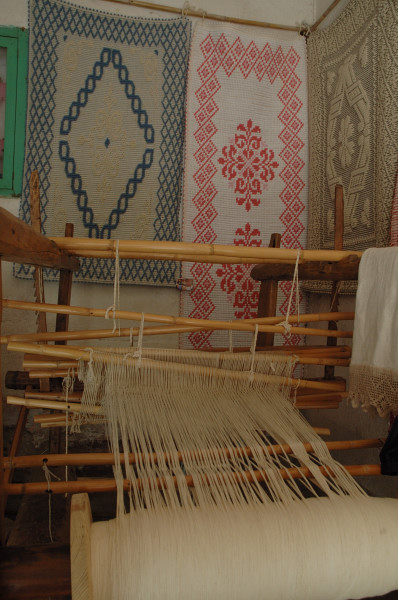
Of the many various types of Sardinian rug, it is worth noting the most outstanding examples; the copricassa, wide and with a striped design placed over the nuptial coffer which contained the various bed-linen and towels for the newlyweds. This rug is still produced by family craftsmen or local schools. The production of tapestries in Sardinia is composed of bedcovers, tablecloths and towels as well as rugs which vary in colour and design depending on its area of production.
Up until thirty or forty years ago it was possible, visiting various villages and towns on the island, and thanks to the long-established tradition of textiles, to see that almost all the women of the zones were positioned in front of the loom, intent on the realisation of rugs. Today, however, of this scenario there remains only a small part.
*The techniques*
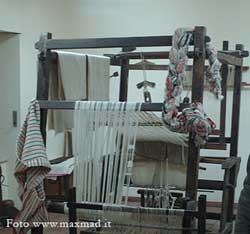
The works of embroidery are realised by way of the loom, used both for cotton and wool weaving. The types of loom most frequently used are horizontal or vertical. The first type is used almost all over the island with which it is possible to obtain different types of textile: curled or grained (pibbionis), laced (lizzos) with alternating movement of the pedals or needlework (a mustra de agu).
The vertical loom is used only in certain mountain villages: Tonara, Nule and Sarule, manufacturing are with smooth or flat tapestries. In Dorgali and Zeddiani a thrid type of loom has recently been adopted: the transverse or oblique loom, that permits a more simple working and a more resistant tapestry and allows the production of knotted or bowed tapestries.
 The most noted centres of production in Sardinia
Vertical loom
Nule: is a village situated in the north-central part of the island, in the zone of Goceano, near Benetutti, very important for the production of smooth tapestry rugs. The traditional rug is polychrome accompanied by a series of elaborations composed of motifs and designs of flora and fauna, similar to Islamic and Byzantine tapestries and motifs of brocades of Genoa and Pisa. The product, obtained by wool working, coloured with vegetable colours, figurative symbols like palms, peacocks, deer and horses, may have various lengths but no wider than three metres.
Oblique or transverse loom
Dorgali: is a village situated on the centre of the oriental coast, near Oliena and not distant from the county town of Nuoro. This village, along with Zeddiani, is the only that produces woollen bowed, knotted rugs, very similar to those produced in the orient. This rug can only be produced thanks to a particular type of loom and skilled weavers.
Horizontal loom
Samugheo: : is a village in which the majority of its inhabitants dedicate their time to this activity using the horizontal loom. The material used is cotton, wool or linen of different tones, while the technique normally adopted is that of 'pibbionis '( curled or grained).